East Village 'Peace House' asks $6.95M
The four-story home at 166 Avenue A was Anton van Dalen's home and studio for more than fifty years, and the PEACE inscription he painted across its facade in the 1990s is part of the property. It asks $6.95M.
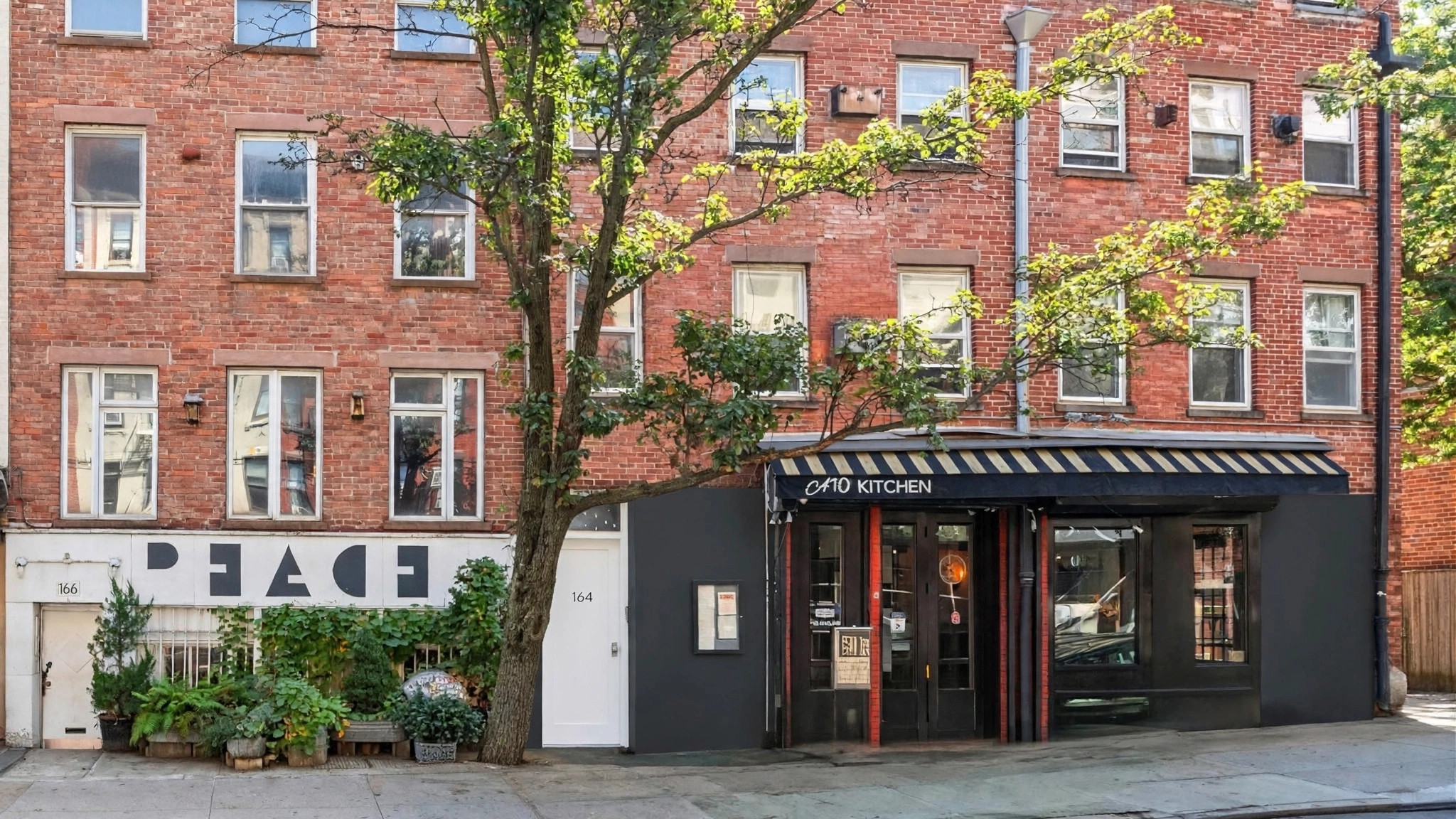
The house at 166 Avenue A announces itself before you know anything about it. Spelled out in abstracted black geometric letters across the white garden-level facade is a single word: PEACE. The four-story, three-family home just north of Tompkins Square Park asks $6,950,000, and the inscription is not staging added for the sale. It is the work of Anton van Dalen, the Dutch-born artist who lived and worked in the house for more than fifty years, who painted it above the ground-floor entryway in the 1990s in response to the Persian Gulf War.
Van Dalen was born in Amstelveen, outside Amsterdam, in 1938. His childhood home was seized by the occupying Nazis during the Second World War, his family emigrated to Toronto in 1954, and he moved to New York in 1966. In the early 1970s he moved with his wife and two young children into the townhouse at 166 Avenue A, buying it with another family, and he stayed for the rest of his life. He called himself a documentarian of the East Village, and his drawings and paintings recorded the neighborhood as it was: the street life, the pigeons, the rooftop coop he kept, the dilapidated buildings and abandoned cars. In a 1986 review in Artforum, the critic John Yau wrote that van Dalen moved to the East Village and addressed the place in his work long before it became either a fashionable place to live or an acceptable subject matter. P.P.O.W showed his work from 2015, and his 1987 painting The Pigeon Car became one of his best-known images. He died in his sleep on June 25, 2024, aged 86.
The house itself is a working artist's house in the literal sense. Built in 1900, it totals 4,520 sqft across three apartments, each with its own configuration, with light from three exposures and views over the neighborhood's gardens. The main duplex was van Dalen's studio, a vaulted, skylit space that could convert into three more bedrooms. Upstairs is the full-floor loft of the glass artist Bill Schneider, with eleven windows, riveted steel beams, and exposed brick. The garden level has three bedrooms and a large lower level opening onto a terrace at the rear. Sotheby's International Realty holds the listing.
What makes the house an artfully story is that the art is the property. Plenty of Manhattan listings can claim a famous former resident; very few are themselves the artwork, with the artist's statement painted across the facade in letters large enough to read from the sidewalk. The Peace House is a piece of East Village history that happens to be for sale, and its value is inseparable from the neighborhood it documents: the community gardens, the rebellious creative spirit, the half-century in which one artist watched one block change and painted what he saw. The question for the next owner is the one the house has posed since the 1990s: how do you live in a work of art without turning it into a monument?