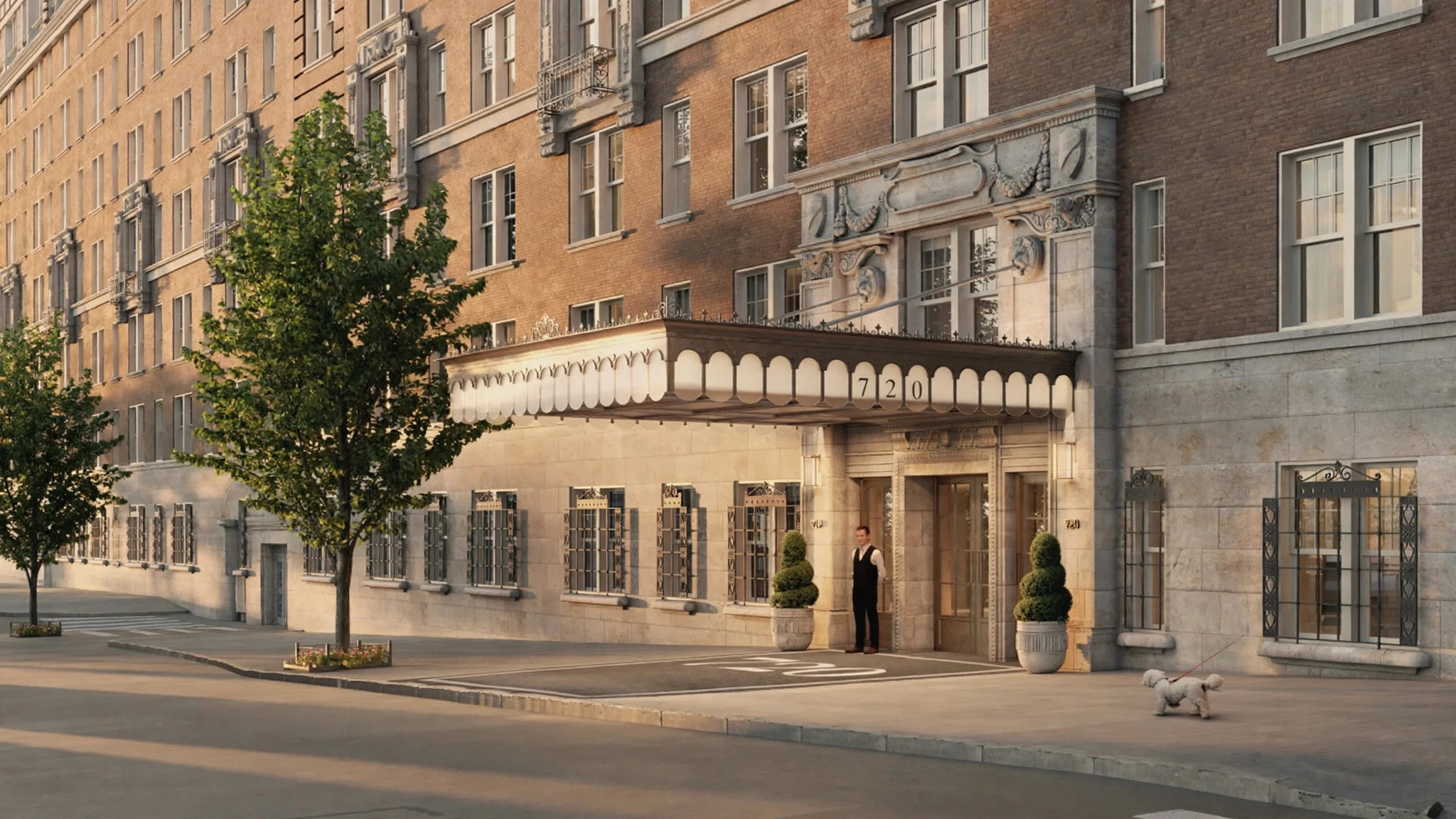
720 West End Avenue, Manhattan
Upper West Side, ManhattanThe Marcy, 720 West End Avenue
An architect's early hotel becomes his final Upper West Side landmark — a century later.
Before Emery Roth built the towers that would define Central Park West — the San Remo, the Beresford, the El Dorado — he built a hotel. In 1927, three years before the San Remo's twin towers rose over the park, Roth designed the Hotel Marcy at 720 West End Avenue: a Renaissance Revival building of stone and brick, understated compared to what he'd design next, but unmistakably his hand at work.
What it was waiting for arrived recently. Glacier Equities and InterVest Capital Partners acquired the building and restored it under Landmarks Preservation Commission oversight, preserving Roth's original stone base, his marquee, the Renaissance Revival brick facade that first went up in 1927. Above that, they added a floor — new duplex penthouses tucked onto a building that was never designed to hold them, a decision that could easily have fought the original architecture. Instead, designer Thomas Juul-Hansen built the interiors to hold "old world charm and substance with the new and modern" in the same rooms, rather than choosing one over the other.
The building now holds 131 units, and among the amenities — a music room, a squash court, a golf simulator — sits something that feels less like an amenity and more like a small act of continuity: an art studio, in a building whose original architect spent his career giving Manhattan's apartment houses their most recognizable faces.
Featured: Penthouse 17C — a four-bedroom duplex on the seventeenth floor, with nineteen hundred square feet of private outdoor space — sits at the top of that second sentence. It is, in its own way, the same argument the rest of the building is making: that a home doesn't have to choose between a landmark's history and a life lived in it now.